KDPM

Friday, April 27, 2007

Once an incumbent, always an incumbent!


Once an incumbent, always an incumbent!

“Lang’ata MP, Mr Raila Odinga, has spoken of the awesome power of incumbency and the dangers of a splintered Opposition, and sent out a fresh plea for unity in ODM-Kenya”. Not many people, especially in his camp, seem to have paid attention to these words which were carried in one of the Kenyan dailies yesterday but they may just hold the secret weapon that will propel President Kibaki back to power.

The flurry of interest, activity and excitement surrounding the 2007 General elections in Kenya is no accident. Almost every constituency is burning and sparks are gonna fly fire, so be prepared. Everyone who follows politics keenly understands the innumerable advantages that incumbency bestows. The power of incumbency is related in no small way to political parties. Conventionally, the power of incumbency has been embedded in the immeasurable fund-raising opportunities, the open media attention and the name recognition that attaches to the president, his ministers and members of parliament. Incumbency is an important barrier facing women because most incumbents are men.In short, incumbency matters a great deal, and the advantage incumbency affords make it difficult for a possibility of widespread defeat for incumbents.

Name recognition is a major factor in being re-elected over and over again. No wonder nepotism has always been alive and well in Kenyan politics. Certain names are associated with wealth and power thus defeating them in any political contest is always a gigantic task. Betting on the re-election of a sitting elected official is like putting money in the bank. That is simply a fact of life in Kenyan politics. The only question is why that happens and what, if anything, can or should be done about it. In many constituencies this year, incumbency remains a powerful force. The current legislators have had an advantage that many of their predecessors did not have. Their fat pay checks enabled them to criss-cross their constituencies bestowing favors on the voters and participating in development project initiatives on a level that has never been witnessed in the past.

In fairness we would have loved to declare that all of the participants in this epic struggle for power in the Kenya are citizens who believe that their strategies and tactics for claiming and holding political power are in the best interests of the nation. We would love to say that even when the ideological divide between the two main factions in this year’s elections become rancorous and divisive, this power struggle will be a debate than a war. Unfortunately, history shows that political debates in Kenya have produced great enmity from time to time on both sides. Enmity has escalated to nasty political tactics and various low-end shenanigans in some cases.

In order to better understand the political game – as in game theory not idle entertainment – we need to know well who the opposing players are in the 2007 elections. Unfortunately, there is no absolute dividing line between the opposing sides. In fact we find some politicos playing both sides of the debate as it suits their personal ambitions. In the main though there are two opposing sides, which can be defined by the ideas, issues and candidates, they support. For most activists and hacks the two factions vying for power are ODM-Kenya and Narc-Kenya. However, there are many identifying characteristics of personalities in both groups which makes it almost impossible to distinguish one group from the other. Both incumbents and aspiring candidates are running with political baggage. Again this serves to the advantage of the incumbent since there is nothing unique or new that one can point out on the opposition side.

Unseating an incumbent requires money, name recognition and deals with local leaders, and often a helping hand from local government officials. Very few of the aspiring opposition contestants this year have strong legislative records and numerous political alliances like the incumbents thus the path to victory will be tougher for them.

Unlike in 2002 when the battle cry for many local Council, parliamentary and even presidential challengers was for reform and change, for fresh faces and new beginnings, the opposition today faces a sitting president who has managed to play his cards safely thus avoiding unnecessary negative politicking. He has also worked hard to steer the country’s economy a step higher than it was when he took over the leadership of the country. Coupled with the fact that the opposition is made up of people with tainted backgrounds, one can almost certainly believe Raila’s words that unseating President Kibaki is going to be a HUGE challenge to the current shaky opposition which is held together not by ideology but by the thirst to grab power and either safeguard their ill-gotten loot or have the opportunity to loot and amass wealth for themselves.

One prayer that the opposition can bank on is that President Kibaki and his lieutenants may rest on their oars thinking that power of incumbency will do the magic for them at the general elections.

So what solution does Raila and his colleagues have? In the perspective of political marketing, an election campaign consists of three phases: exploration of the political demand, creation of the political offer, promotion of the offer. Despite the different contexts in each constituency and in each election year, are there strategies that could be shared by all aspiring challengers?

Monday, April 23, 2007

NIGERIA VOTES -2007!


Another record has been broken in Nigeria! A civilian has been elected to succeed President Olusegon Obasanjo. Alhaji Umaru Musa Yar’adua, a former chemistry teacher, is set to be Nigeria's first university educated leader

Alhaji Umaru Musa Yar’adua, the Executive Governor of Katsina State, was born in Katsina Town, Katsina State in 1951. He started his primary education at Rafukka Primary School, Katsina in 1958. He left Rafukka for Dutsinma Boarding Primary School in 1962 from where he completed his primary education in 1964.

Between 1965-1969, Umaru Yar’adua was at Government College, Keffi in present-day Nasarawa State for his secondary education. He then moved to the famous Barewa College Zaria for his Higher School Certificate between 1970-1971. For his university education, Yar’adua attended the Ahmadu Bello University (ABU) Zaria from 1972-1975 where he obtained the B.Sc Education/Chemistry. He returned to the same University from 1978-1980 for his M.Sc Degree in Analytical Chemistry.

During his tenure as Governor, the state has gone through an unprecedented development, culminating in profoundly transformation of the educational and health institutions, provision of rural and urban roads, electrification, water supply and agriculture. Today, people of Katsina State can boast of a Governor with proven record of prudence, accountability and transparency. Under his leadership, Katsina State now has a surplus of N6.5billion from a near empty treasury and back log of debts in 1999. No wonder, Umaru Yar’adua won the National Primary Education Productivity Merit Award in 2004 and the Central Bank of Nigeria (CBN) Best Governor Award under the Agricultural Credit Guarantee Scheme (ACGS) in 2005. Yar’adua’s primary health care delivery system and primary education policies have become models with compelling national appeal. His determination to make taxation the major source of public finance in Katsina State has currently pre-occupied his administration with implementation of plans to process and make viable neem production in the State. This is expected to bring in export revenue in excess of USD2billion to farmers and people of Katsina State. The Governor further expects 25% of this or USD500 million to accrue to the state treasury as revenue for the sustenance of his efforts. He was honoured with many other awards for prudence and accountability, among which are NUJ Abuja Council (2003); NUJ Kaduna Council (2005) and Leadership Watch (2004).

Source: http://www.yaradua2007.com/index.php?option=com_content&task=view&id=14&Itemid=26

Wednesday, April 18, 2007

THE ISSUES THAT WILL BRING PRESIDENT KIBAKI'S GOVERNMENT DOWN!

STANDARD GROUP COMMENT:Stop this vendetta against us

The great tragedy of our day is that the lowest form of propaganda and blackmail — lack of information, misinformation, disinformation, and a contempt for the truth and the reality of most citizens’ lives — has overridden the golden credo that Government exists to do no harm and for the good of all.

This is obviously the case in Kenya today when a section of Government withdraws advertising from the Standard Group Limited on the spurious grounds that the media house is adversarial to it. The harm intended is financial incapacitation — a scheme that is doomed to fail.

This is obviously the case when the same elements in Government detain the top management of the same company for a story it ran from verifiable sources instead of investigating the serious allegations contained in the story.

This is obviously the case when State resources are marshalled to intimidate a media house whose only crime is executing its legitimate mandate in the public interest when such resources could make a huge difference in the Mt Elgon region, currently experiencing fatal clashes between our citizenry.

This is obviously the case when those who strive to defend the honour of our nation against the sacrilegious defilement by two miscreants — just two of them — are given a bad name and handed the punishment due to the miscreants.

This is obviously the case when the security situation in the country has degenerated to alarming levels and all the minister in charge can do is read threatening and intimidating statements against a media house that is known to harbour no criminal.

What are the issues here? The issues simply are that the Standard Group Ltd (SGL) has been under consistent attack from a section of Government — repeat a section of Government — for the better part of two years when the country is facing greater challenges.

Not only have our employees been physically assaulted, we have been raided, our property destroyed, ours editors illegally held, our transmission interrupted, our press disabled, our newspapers burnt, our directors harassed and now advertising discontinued.

Why all this? Because of two foreign miscreants without as much as fleeting respect for our country, our leadership or our culture.

Lest we forget, let us refresh our memory. The media exists to report accurately and, yes, responsibly on matters of public interest. The Artur saga is a matter of great public interest. SGL did not create the Artur brothers. SGL did not invite them to Kenya. SGL did not dictate who their handlers were. SGL did not even deport them, if they were indeed deported. The Government knows who did all this.

Our coverage of this issue has been consistent with that of any responsible corporate citizen, particularly a media house. In fact, the Standard considered claims that the Arturs were here and were planning grievous harm frivolous until we were raided by, among others, people witnesses say were of Caucasian origin.

SGL was the first to come to Internal Security Minister Mr John Michuki’s defence when Artur Margaryan ordered him to shut up. Whereas the usually courageous and forthright minister kept quiet to the consternation of many, we stepped forward to defend the honour of our leadership. We were the first to call for the duo’s deportation. We were the first to call for an inquiry into their activities. We were the first to wonder aloud how the duo could threaten to unleash dogs on our Police Commissioner. We have behaved like any proud and responsible corporate citizen should.

Question: Is the love for this great nation restricted to words without actions? Was SGL being irresponsible or anti-Government by defending the honour of the same Government? Who should be under interrogation here, us who have kept Kenyans informed or those who want to muzzle us?

Therefore, and justifiably so, we take great exception to the renewed harassment and intimidation from a section of Government.

Yesterday, an e-mail instruction made available to us clearly states that all Kenya Power and Lighting Company (KPLC) adverts booked in our newspaper and television station were to be cancelled immediately and redirected to other media houses.

Others that have been given similar directives by the Government and immediately acted upon include Moi Teaching and Referral Hospital and parastatals in the ministries of Agriculture, Education and Health.

The question that must be asked is: Is there an attempt to peg advertising to favourable media coverage? What is this supposed to tell those citizens — taxpaying and otherwise — whose only source of information is The Standard and KTN? That they don’t matter or that for their Government to communicate with them, they must consume media of the Government’s choice?

Of course we are alive to the wisdom of Thomas Jefferson, a former President of the United States of America, who once said: "The functionaries of every government have propensities to command at will the liberty and property of their constituents. There is no safe deposit for these but with the people themselves, nor can they be safe with them without information. Where the Press is free, and every man able to read, all is safe…

"The most effectual engines for (pacifying a nation) are the public (news)papers… (A despotic) government always (keeps) a kind of standing army of news writers who, without any regard to truth or to what should be like truth, (invent) and put into the papers whatever might serve the ministers. This suffices with the mass of the people who have no means of distinguishing the false from the true paragraphs of a newspaper."

Whether this holds true in Kenya’s situation despite highly positive opinion polls is for every individual Kenyan to judge.

Anyhow, we wish to reiterate our position: We are an independent media house that publishes content we believe serves compelling public interest and not one that panders to individual egos.

In executing that mandate, we have the resolve of a river that must reach its destination and for this our journalists and managers are well-prepared. We are not enemies of Government and we believe with its intelligence networks, the Government can ascertain that easily.

On Monday, we published a story that led to this state of affairs. We stand by that story and here below repeat some of the questions we raised which remain unanswered:

• Why did a layman, a former policeman named Shedrach Kiruki, and not a legal expert head the commission of inquiry into the activities of the Arturs?

• Why were certain parties, such as SGL, denied the opportunity to testify at the inquiry? After all, the Arturs allegedly led the squad that raided the Group on March 2 last year — a raid captured on CCTV, and which Michuki has termed a Government operation.

• Why was a lawyer who sought to represent the Arturs at the commission not allowed to have his day on the stand?

• The commission’s report, the Government said, would not be made public because it touches on sensitive matters of security. Why is the minister in charge of that security still in office?

• Is there any truth in claims by Mr Raila Odinga, the Lang’ata MP, that these men were mercenaries? Whose dogs of war were they?

• The Arturs drove around in cars bearing Government registration plates. If the plates were faked, why were they not arrested and arraigned? If they were real, how did they get them and for what missions?

• The Arturs had security passes that gave them access to any part of any of Kenya’s airports at any time. Only the very apex of the Kenya Airports Authority pyramid can issue such passes. But at whose behest and for what reason?

• Immigration Minister Gedion Konchellah defended the Arturs saying they were investors. In what sector of the national economy were they interested?

• On whose advice was Konchellah and Government Spokesman Dr Alfred Mutua acting when they told Kenyans that the Arturs were investors on H class visas and work permits? On whose authority were they issuing such statements on people who would later be declared persona non grata?

• On whose advice was Konchellah acting when he authorised the issuance of passports to the two?

• It is on record that it was the National Security Intelligence Service (NSIS) that vetted and cleared the two men to get Kenyan passports! Is this true and at whose behest and for what purpose?

• Did Michuki know that the Arturs had documents making them high-ranking police officers — Deputy Commissioners to be precise? Did the Arturs in that capacity or otherwise lead the assault on SGL on March 2, last year? Did Michuki know that Margaryan was one of his officers? Did he know that the man was tasked with training some of the members of his elite squads? Are Kenyans not damned if he did not know? Are they not damned if he knew?

• It should be recalled that the commission of inquiry heard witnesses recount how the Arturs were helped to stage-manage an arrival at JKIA and how they were allowed to use the VIP Lounge and insult the whole country’s poverty. If this is not a serious enough indictment on those who manage our security and airports, what is? Why are those people who presided over this national disgrace still in office?

Instead of our Internal Security minister sitting on his official chair to put up a show and threaten the media, he should provide answers to these questions or simply have the honour to resign. And Mr Michuki this is not personal vendetta. If you want evidence, consider that the First Lady, Mrs Lucy Kibaki, has found time to visit and commiserate with the victims of Mt Elgon clashes. You have not. Is this personal vendetta?

For his own good reasons, the President has chosen to keep Michuki as his minister in charge of Internal Security. But as a media house, we wish to tell our President that the vast majority of Kenyans have no confidence in this minister who might have been a success in the Transport portfolio but has been an unmitigated failure in Internal Security. Your Excellency, Vox Populi, Vox Dei.

For their solidarity and support, we thank our readers and viewers, the international community, the local media who have rightly realised that this is not a war against the Standard but a war against the entire media, our political leaders both from the Government and Opposition who have rallied to our defence, religious organisations and advertisers who have stood by us despite all.

They have all done well for as Martin Luther King, Jr said: "In the end, we will remember not the words of our enemies, but the silence of our friends."

On this we stand.

Source:http://www.eastandard.net/hm_news/news.php?articleid=1143967479

Monday, April 16, 2007

A BIRD'S EYE AT NAMBALE CONSTITUENCY


BACKGROUND: Busia District Profile

Busia District is one of the districts comprised in Western Province, Kenya. Butere Mumias District borders it to the east, Bungoma District to the north east, Teso District to the north, Siaya District to the south east, Bondo District to the south and the Republic of Uganda to the west. The District of over 600,000 people covers an area of 1,261.3 square kilometers, 137 square kilometers of which is under permanent water surface - Lake Victoria. The mean annual rainfall for the district is 1500mm with most parts of the district receiving between 1,270mm and 1,790mm. During the long rains, crops such as maize, sorghum, sweet potatoes, soya beans, cowpeas, green grams and beans are grown in most parts of the district. Though not highly practiced, the land can grow quick maturing crops such as kales, simsim and sunflower, as well as, long-term crops such as sugarcane, robusta coffee, cassava, avocados, oranges, and bananas. The district is further subdivided into 5 administrative divisions namely, Butula, Nambale, Matayos, Funyula and Budalangi.

PROBLEM STATEMENT

Nambale constituency in Busia district is one of the underdeveloped areas and according to World Food Program report for 2005, the area has higher prevalence of HIV/AIDS and 36% of its citizen lives in “hardcore poverty”, a condition where food needs cannot be met even when a family’s expenditure is entirely on food. The level of “absolute poverty” (i.e. in ability to meet basic food and non-food needs) is estimated at 54%. Generally schools within the area have very little infrastructure for learning. On community level, inadequate information, inaccessible tools and skills to fight poverty as well as generational cycles of poverty have for so long suppressed individual’s innovativeness, creativity and entrepreneurship potential. The community has determined farmers with no access to crucial farming technology and entrepreneurs with inadequate information on their trade. The sum of all these challenges is forcing young people, the active work-force, to migrate to the cities disrupting the community’s civic commitment and scuttling hopes for community development.

KEY PERSONS

Hon. Amos Wako – Attorney General, Republic of Kenya
Hon. Chris Okemo – MP, Nambale Constituency
Mr. Philip J.W. Masinde – Former MP, Nambale Constituency
Mr. Sakwa Bunyasi – Retired employee of World Bank & 2007 Parliamentary Aspirant (Nambale Constituency)
Mrs.Lydiah A.Achode- High Court Registrar
Retired Rev. Canon Ngota – A.C.K Church, Busende Parish
Engineer Dan Barasa – Ministry of Water Resource and Development.
Mr. Nyongesa Wandera – University of Nairobi (Student), Coordinator (Students for Rural Community Development), Moderator (Bukhayo Youth Action)
(Please feel free to give us more names of prominent personalities from Nambale Constituency)
PROJECT RECOMENDATIONS

Regeneration of the Nambale Cotton Ginnery
Revival of Matayo’s Youth Polytechnic
Development of Busende Secondary School
Setting up of a Tertiary Learning Institution in the District
Development of the Nambale Sugar Factory
The establishment of the Nambale University

(Thanks to Henry Victor Okumu for the research and compilation of this information)

Tuesday, March 06, 2007

J. Edgar Hoover, Organized Crime and the Global Village!


Cross-dressing FBI Director J. Edgar Hoover presided over the greatest development of organized crime America has ever seen

Did you know that if we could reduce the world's population to a village of precisely 100 people, with all existing human ratios remaining the same, the demographics would look something like this:

60 Asians
14 Africans
12 Europeans
8 Latin Americans
5 North Americans AND Canadians

Of all of the above, 82 would be non-white and only 18 would be "white".

67 would be non-Christian and only 33 would be Christian.

5 would control 32% of the entire world's wealth, and all of them would be US citizens

80 would live in substandard housing

24 would not have any electricity (And of the 76% that do have electricity, most would only use it for light at night.)

67 would be unable to read

1 (only one) would have a college education.

50 would be malnourished and 1 dying of starvation

33 would be without access to a safe water supply

7 people would have access to the Internet

If there is a meal in your refrigerator, if you are dressed and have got shoes, if you have a bed and a roof above your head, you are better off, than 75% of people in this world.

If you have a bank account, money in your purse and there is some trifle in your coin box, you belong to 8% of well-provided people in this world.

If you are able to go to church, mosque or synagogue without fear of harassment, arrest, torture or death, you are better off than 3 billion persons in this world.

I guess you notice that Americans are in the minority population wise and yet they control the majority of the world's wealth. How do you think this happened? Divine intervention? An 'enterprizing spirit'? What do you think will happen if that majority of people ever really gets it in their head that America is an intolerable bully and must no longer be tolerated? Sure, America could bomb the hell out of the planet and reduce our lives to a Stone Age existence, but then that would be rather like cutting off our noses to spite our faces, now wouldn't it?

Source:
http://www.signs-of-the-times.org/signs/editorials/signs20061113_JohnFKennedyJEdgarHooverOrganizedCrimeandtheGlobalVillage.php

Monday, February 12, 2007

AMERICA & AN UNFAIR SYSTEM.


This segment of the video(The Power of Illusion) drove home the point of how pervasive white privilege truly is in our society. We have inherited an unfair system in which all whites, racist or not, benefit from the system. Due to practices like “red lining” in the housing market and courts determining which races are “white” or “non-white” for purposes of citizenship, people of color have never been granted equal access to American society. We were disturbed to learn that people were denied citizenship due to race until 1952. Even more disturbing is the fact that this institutional racism is so embedded in American society that the United States government actually sanctioned such practices. These “details” tend to become hidden and forgotten because they're a part of "the system" that we all live in, but they still have extremely detrimental effects. Amazingly, people today still fail to comprehend or see the whole picture and the damage that has been done.
In the Power of an Illusion, we see racial markers like skin color, hair texture, etc., mean nothing, until they are judged by American society. Experience has shown that where there are inappropriate policies and repressive laws coupled with a systematic stifling of a people’s entrepreneurial skills, the whole society, both the oppressor and the oppressed suffer. If American society fails to come to terms with this “beast,” she will live “arrested” forever. It takes courage, sacrifice, and humility to come to a point of an all-embracing and crystallization of a whole society’s inner hopes and dreams. Without it, that society remains an empty shell, a rudimentary and fragile caricature of what it might have been.

This is our group response after watching the Video 'The Power of Illusion' in the Race, Class & Language class at Grand Valley State University.

Wednesday, January 31, 2007

Just Remove the Roadblocks!

Okot p'Bitek


Commenting recently on a recommendation that was given by the Report of the New Commission On the Skills of the American Workforce which asked that American students from less priviledged/high risk neighbourhoods be given more resources to enable them receive quality education and compete with the other American students, one good person surprised me by retorting sarcastically "just give them a bunch of money and new parents!"

The bottom line for the ordinary person can only be summarized by the main character in Okot p’Bitek’s poem, Song of an African Woman. Addressing her man, she says: "I have only one request. I do not ask for money, although I have need for it. I do not ask for meat, although I could do with some. I have only one request. And all I ask is that you remove the roadblock from my path!" In other words, people will not be excited by grand gestures, although they could do with some. What they want is for every government to remove the roadblocks planted in their path.

Friday, January 26, 2007

I AM AN AFRICAN! OPRAH WINFREY!


“I know that none dare challenge me when I say - I am an African!” (http://www.nathanielturner.com/iamanafrican.htm) Like, President Thabo Mbeki of South Africa, today Oprah Winfrey can confidently say these words without a shadow of a doubt. Thanks to history and technology.

I could not stop shedding tears as I watched Oprah being told about where her great grand parents came from. The historians/researchers who took up the responsibility of digging up Oprah’s roots did a superb job and one could not help but just marvel at their discoveries. I am sure the Mande-Fu (Kpelle) tribe of Liberia will be overwhelmed to find out that Oprah is one of their own. The Kpelle, Gio, Mano, Mandingo and Vai groups migrated from the Empire of Mali for various reasons. Some escaping political intrigue others looking for a better life.( http://en.wikipedia.org/wiki/Culture_of_Liberia)

This discoveries open a new chapter that may lead more African Americans to find out where they came from and without any doubt, the African leaders will be forced to reconsider their leadership styles when they find out that some of their own brothers and sisters like Barack Obama and Oprah Winfrey are watching their actions and they have every right to question them.

Monday, January 22, 2007

I AM BECAUSE WE ARE!

The Katumbi market.
FMBC students Kisimba Saidi and Ibrahimu Patilo traveling back home from Bible school.
FMBC student Kisimba Saidi welcoming FM missionary to his home.
Inside the house.
Smaller boats transporting people and goods to and from the bigger boat.

Dr.Mortimer J. Adler


“Not to engage in the pursuit of ideas is to live like ants instead of like men.”

Adler said at one time that "the underestimation of the human intelligence is the worst sin of our time." He saw his task as the restoration of philosophy "to its proper place in our culture." Regarding modern philosophy, Adler said (in an interview with Michiko Kakutani of the New York Times) that "the twentieth century, for the most part, is an age in which relativism, skepticism, and subjectivism are rampant, and that's what I'm mainly fighting against...modern philosophy got off to a bad start when Descartes and Locke committed the 'besetting sin of modern thought', they ignored Aristotle."

Dr.Mortimer J. Adler (1902–2001)
Philosopher and Educator
GSAS 1928
Faculty 1923–29

Monday, January 08, 2007

Honesty! An Elusive Virtue in the Church in Africa!


Kids are amazing in many ways.Every time I would tell my 9-year daughter, Cheryl something via yahoo instant messaging on the internet, she would write "True?" or "Kweli" in Swahili.In other words, she wanted me to confirm to her that whatever I was telling her is honest and true. She did not want me to come back to her and say I was sorry because what I told her was not true. How I wish all adults,especially Christians, would do the same. A quote from wikipedia.org says, “Honesty is the human quality of communicating and acting truthful and with fairness, as best one is able. It is related to truth as a value. This includes listening, reasoning and any action in the human repertoire — as well as speaking.

Superficially, honesty means simply, stating facts and views as best as one truly believes them to be. It includes both honesty to others, and to oneself and about ones own motives and inner reality.”

History has shown that whenever “small”or evil-minded people find themselves cornered or in trouble because of sin,failure etc,instead of being mature and responsible enough to face and own their sin and failures, they try to get out of their troubles by distracting those who would go after them by speaking dishonestly about others, distorting the truth, mudslinging and appealing to the emotions of their audience.Fortunately, in cases where there is effective discernment and reflection such simple, shallow and naive tactics never succeed for long. They may be entertained for a short period or time but eventually, the truth comes out and the true character and spiritual fabric of the perpetrators is exposed leading to their miserable but inevitable downfall. There is a common saying that ability can get one to the top, but it takes character to stay there. The same author of the statements cited above continues to say, “Since the quality of honesty applies to all behaviors, one cannot refuse to consider factual information, for example, in an unbiased manner and still claim that one's knowledge, belief or position is an attempt to be truthful. Such a belief is clearly a product of one's desires and simply has nothing to do with the human ability to know. Basing one's positions on what one wants — rather than unbiased evidence gathering — is dishonest even when good intentions can be cited — after all even Hitler could cite good intentions and intended glory for a select group of people. Clearly then, an unbiased approach to the truth is a requirement of honesty.”

Christian leaders are called upon to be truthful, honest and factual in all their dealings. The need for these virtues cannot be overstated in the church in Africa.Professor S. Richards who is teaching the Educational Policy and Practice course which am taking this semester in one of her articles says that it is vital to learn how to evaluate an argument calmly and objectively.She says that one should always ask the following questions:
1.How empirical is the presentation?
2.What is fact? What is opinion?
3.Is propaganda being used? If so, what is the motive and/or hidden agenda?
4.What cause/effect relationships are proposed?
5.Are these cause/effect relationships merely correlations?
6.Is information distorted or taken out of context?
7.Are analogies faulty?
8.Is the author over-simplifying the issue?
9.Is the author stereotyping?
10.Are there faulty generalizations?

It is always crucial and important to evaluate the character of all parties in a dispute.It doesnt help to just be carried away by emotions.Aristotle classified emotional appeals (pathos) as one of the most effective means of influencing others.Practiced publicists and cunning propagandists play on emotions and distort the truth to suit their own selfish ends.But, at the end of the day, it is factual claims and logical argument that need to prevail.

Saturday, November 11, 2006

Meet Dr.Chuck Pierce-A Man After God's Heart!


This weekend I had the priviledge of attending a holy spirit-filled, fire-baptized, anointing- saturated Christian revival meeting in Ann Arbor, Michigan. There was a host of world-known and very respected teachers and preachers of the Word of God. The most precious and memorable moment for me was when Dr.Chuck Pierce placed his hand on my heart and prayed over me. I could literally feel the presence of God all over me. Life will never be the same again.

Thursday, November 09, 2006

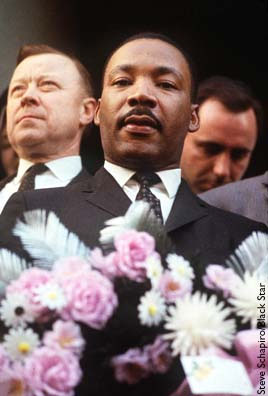
I Have a Dream! -The Rev. Martin Luther King, Jr


I Have a Dream
The Rev. Martin Luther King, Jr
Aug. 28, 1963
1965: In early March, shortly before leading civil rights demonstrators from Selma to Montgomery, Ala., King attended a memorial service for Reverend James Reeb, a white clergyman from Boston who was killed by white thugs in Selma.

King was a student of Mahatma Gandhi's extraordinarily successful non-violent methods of civil protest, and adopted them as a staunch theme of the American civil rights movement.


Here is the historic speech that this great son of a woman made before he died:

"Five score years ago, a great American, in whose symbolic shadow we stand signed the Emancipation Proclamation. This momentous decree came as a great beacon light of hope to millions of Negro slaves who had been seared in the flames of withering injustice. It came as a joyous daybreak to end the long night of captivity. But one hundred years later, we must face the tragic fact that the Negro is still not free.

One hundred years later, the life of the Negro is still sadly crippled by the manacles of segregation and the chains of discrimination. One hundred years later, the Negro lives on a lonely island of poverty in the midst of a vast ocean of material prosperity. One hundred years later, the Negro is still languishing in the corners of American society and finds himself an exile in his own land.

So we have come here today to dramatize an appalling condition. In a sense we have come to our nation's capital to cash a check. When the architects of our republic wrote the magnificent words of the Constitution and the Declaration of Independence, they were signing a promissory note to which every American was to fall heir.

This note was a promise that all men would be guaranteed the inalienable rights of life, liberty, and the pursuit of happiness. It is obvious today that America has defaulted on this promissory note insofar as her citizens of color are concerned. Instead of honoring this sacred obligation, America has given the Negro people a bad check which has come back marked "insufficient funds." But we refuse to believe that the bank of justice is bankrupt. We refuse to believe that there are insufficient funds in the great vaults of opportunity of this nation.

So we have come to cash this check -- a check that will give us upon demand the riches of freedom and the security of justice. We have also come to this hallowed spot to remind America of the fierce urgency of now. This is no time to engage in the luxury of cooling off or to take the tranquilizing drug of gradualism. Now is the time to rise from the dark and desolate valley of segregation to the sunlit path of racial justice. Now is the time to open the doors of opportunity to all of God's children. Now is the time to lift our nation from the quicksands of racial injustice to the solid rock of brotherhood.

It would be fatal for the nation to overlook the urgency of the moment and to underestimate the determination of the Negro. This sweltering summer of the Negro's legitimate discontent will not pass until there is an invigorating autumn of freedom and equality. Nineteen sixty-three is not an end, but a beginning. Those who hope that the Negro needed to blow off steam and will now be content will have a rude awakening if the nation returns to business as usual. There will be neither rest nor tranquility in America until the Negro is granted his citizenship rights.

The whirlwinds of revolt will continue to shake the foundations of our nation until the bright day of justice emerges. But there is something that I must say to my people who stand on the warm threshold which leads into the palace of justice. In the process of gaining our rightful place we must not be guilty of wrongful deeds. Let us not seek to satisfy our thirst for freedom by drinking from the cup of bitterness and hatred.

We must forever conduct our struggle on the high plane of dignity and discipline. we must not allow our creative protest to degenerate into physical violence. Again and again we must rise to the majestic heights of meeting physical force with soul force.

The marvelous new militancy which has engulfed the Negro community must not lead us to distrust of all white people, for many of our white brothers, as evidenced by their presence here today, have come to realize that their destiny is tied up with our destiny and their freedom is inextricably bound to our freedom.

We cannot walk alone. And as we walk, we must make the pledge that we shall march ahead. We cannot turn back. There are those who are asking the devotees of civil rights, "When will you be satisfied?" we can never be satisfied as long as our bodies, heavy with the fatigue of travel, cannot gain lodging in the motels of the highways and the hotels of the cities. We cannot be satisfied as long as the Negro's basic mobility is from a smaller ghetto to a larger one. We can never be satisfied as long as a Negro in Mississippi cannot vote and a Negro in New York believes he has nothing for which to vote. No, no, we are not satisfied, and we will not be satisfied until justice rolls down like waters and righteousness like a mighty stream.

I am not unmindful that some of you have come here out of great trials and tribulations. Some of you have come fresh from narrow cells. Some of you have come from areas where your quest for freedom left you battered by the storms of persecution and staggered by the winds of police brutality. You have been the veterans of creative suffering. Continue to work with the faith that unearned suffering is redemptive.

Go back to Mississippi, go back to Alabama, go back to Georgia, go back to Louisiana, go back to the slums and ghettos of our northern cities, knowing that somehow this situation can and will be changed. Let us not wallow in the valley of despair. I say to you today, my friends, that in spite of the difficulties and frustrations of the moment, I still have a dream. It is a dream deeply rooted in the American dream.

I have a dream that one day this nation will rise up and live out the true meaning of its creed: "We hold these truths to be self-evident: that all men are created equal." I have a dream that one day on the red hills of Georgia the sons of former slaves and the sons of former slaveowners will be able to sit down together at a table of brotherhood. I have a dream that one day even the state of Mississippi, a desert state, sweltering with the heat of injustice and oppression, will be transformed into an oasis of freedom and justice. I have a dream that my four children will one day live in a nation where they will not be judged by the color of their skin but by the content of their character. I have a dream today.

I have a dream that one day the state of Alabama, whose governor's lips are presently dripping with the words of interposition and nullification, will be transformed into a situation where little black boys and black girls will be able to join hands with little white boys and white girls and walk together as sisters and brothers. I have a dream today. I have a dream that one day every valley shall be exalted, every hill and mountain shall be made low, the rough places will be made plain, and the crooked places will be made straight, and the glory of the Lord shall be revealed, and all flesh shall see it together. This is our hope. This is the faith with which I return to the South. With this faith we will be able to hew out of the mountain of despair a stone of hope. With this faith we will be able to transform the jangling discords of our nation into a beautiful symphony of brotherhood. With this faith we will be able to work together, to pray together, to struggle together, to go to jail together, to stand up for freedom together, knowing that we will be free one day.

This will be the day when all of God's children will be able to sing with a new meaning, "My country, 'tis of thee, sweet land of liberty, of thee I sing. Land where my fathers died, land of the pilgrim's pride, from every mountainside, let freedom ring." And if America is to be a great nation, this must become true. So let freedom ring from the prodigious hilltops of New Hampshire. Let freedom ring from the mighty mountains of New York. Let freedom ring from the heightening Alleghenies of Pennsylvania! Let freedom ring from the snowcapped Rockies of Colorado! Let freedom ring from the curvaceous peaks of California! But not only that; let freedom ring from Stone Mountain of Georgia! Let freedom ring from Lookout Mountain of Tennessee! Let freedom ring from every hill and every molehill of Mississippi. From every mountainside, let freedom ring.

When we let freedom ring, when we let it ring from every village and every hamlet, from every state and every city, we will be able to speed up that day when all of God's children, black men and white men, Jews and Gentiles, Protestants and Catholics, will be able to join hands and sing in the words of the old Negro spiritual, "Free at last! Free at last! Thank God Almighty, we are free at last!"

Tuesday, November 07, 2006

God's "Angel"


Angels! A lot of responsibilities have been handed over to them in Jewish and Christian tradition, in myths and legends and folk theology. Communities have been speculating at it for 4000 years, probably longer. Angels are sent by God to convey the reality, particularly the immense truths, to particular people in decisive states of affairs. The principal truth (the one that Jesus Christ was existing, dying testimony of) is that God is with us and for us, and the angel is here as a part of that. God's communication can be a admonition, or be a consolation in moments of risk and fright.

Today I want to thank God for his “angel” that conveyed a very encouraging message to me. Only God knows how grateful I am to this brother. His name is Joshua Van Til. May the Lord bless him abundantly.

Sunday, October 22, 2006

THE LAW OF THE LID: REFLECTING ON THE FREE METHODIST CHURCH IN TANZANIA


Renowned teacher and speaker on the subject of Leadership, John Maxwell says that leadership ability determines a person’s level of effectiveness. In essence, our leadership level determines our organization’s level of growth in all aspects. It determines our church’s size, maturity etc.Our leadership is like a lid. It keeps anything underneath from going higher. The lid keeps everything underneath from growing and reaching it’s potential. It is almost impossible to see a situation where the organization grew beyond the lid of the organization. Leadership determines the size of the organization. If my leadership is 4 out of 10, my organization will most likely grow to 3-out-of-10. You don’t have a 4-out-of-10 type of leader leading a 7-out-of-10 type of church or organization. It just doesn’t happen.

A growing organization is the result of a growing leader. Grow a leader and you grow his church or organization. The leader is the lid. Grow it up. Lifting the lid is serious business. It needs to be taken seriously. We cannot have growth without growing leaders. In Proverbs 29 we see that when good people run things, everyone is glad. In the Old Testament, when Israel had a good king they prospered. When they had an evil king they went down the tubes.

The very fact that an organization is going down means that we have the wrong leader. If the organization is declining, it’s because you have a declining leader. If an organization is on a plateau, it’s because it has a leader who is on a plateau. He cannot climb higher.

Don Stevenson, Former President of Global Hospitality in San Diego, CA, a company that bought out other resorts that were going under said that they would take over a resort that was going under, fire the President, turn it around by re-training the workers, make a profit and sell it.According to Stevenson, everything rises and falls on leadership. You cannot expect a church, business, institution, organization or country to turn around and become successful when you have the wrong leader in the highest office. It just does not happen!

The Free Methodist Church in Tanzania has been on a plateau for several years now. In fact, right from the beginning there were problems in the FMCT. Tribalism, nepotism, corruption, witchcraft etc Most of them were because of poor leadership. The leaders that the FMCT has had in the last 10 years have been people who are either not growing or are declining. As a result, the FMCT has been going under in almost every aspect. The establishment of a leadership training program (The Free Methodist Bible College) for the leaders of the FMCT was meant to address this problem. Unfortunately, for reasons beyond explanation, that program had to be closed down. This has only served to aggravate the leadership problem in the FMCT.

Expecting people with very little or no ministry training at all to grow vibrant churches, lead departments in the denomination and have a vision and ministry plan of action in the whole country is a mere joke. It would take a miracle for that to happen. Let us be realistic. Where else have we seen it happening? I know some of you will ask me to look at the disciples of Jesus Christ and see how many of them had high school education or a college degree. Doing that is only being myopic. It is irrelevant and naïve to cast Greek paradigms in a country like Tanzania which has a totally different context all together.

I hate to say it but the reality is that the FMCT is fast becoming a graveyard of spirituality and it’s only a matter of days before it is erased from the books of the church. Many of her members, though not taken out in a coffin, have been left crippled or stunted in ways either subtle or conspicuous.I hope someone with a burden for that church is reading this. The FMCT needs immediate attention if it is to survive. I do not care what you say but the truth is, the FMCT is in a “spiritual intensive unit”! Get me right, I am not being arrogant. I am speaking this from the bottom of my heart knowing very well that it may not go down within some quarters but history would judge me if I did not speak out at such a time.

In such times, it doesn’t help to bring up Chanceldonian controversies. What needs to happen is just to address the question of leadership in that church and save it or ignore it and let it go under. Godliness does not automatically translate into great leadership. That is a fact. Following the laid-down procedures of electing and selecting leaders is not the solution in the FMCT crisis. Something more urgent needs to be down possibly by the Congo General Conference and the East and Central Africa Area Fellowship if it still exists.Spiritual laissez-faire will not help in any way.Eugene Peterson says, “The French have a wonderful phrase, deformation professionale, to refer to maladies that we are particularly liable to in the course of pursuing our line of work. Physicians are in constant danger of becoming calloused to suffering, lawyers in danger of cynicism about justice, and those of us who think and talk and read and write God are in danger of having the very words we use about God separate us from God, the most damning deformation of all". In the same light, those of us who think and talk and read and write the FMC Book of Discipline are in danger of having the very words we use about church discipline separate us from the Church.

I am not suggesting that the leaders of the FMCT are not saved. Neither am I implying that they are not sanctified. I am only saying that they do not have the capacity to grow great churches. The law of the lid in their case dictates so at the moment. The only thing we can do to help the FMCT is to first have the will to save that church. Lack of goodwill at all upper levels in the worldwide FMC is a major hindrance at the moment.There maybe genuine reasons for this and they may need to be addressed too.But the next crucial thing that needs to happen is to come up with a practical plan for leadership training. Then we can recruit suitable leaders to oversee the leadership development plan. Let me hasten to say that a patient cannot treat himself so it is childish for any of the leaders in the FMCT to be entrusted with the responsibility of heading the leadership training program should it become a reality one day.It is not going to be easy. Some of us will not come out unscathed, but that is the price of leadership.It is not without considerable trepidation that I have opted to walk this path.

Friday, October 20, 2006

"Make room for the human imagination" Bishop Timothy W. Whitaker


Beautiful Belief


On behalf of the Florida Conference I wish to express my appreciation to the Sherman family and to the Candler School of Theology for the Sherman Scholarship program. This generous trust makes it possible for Floridians as well as others to receive a theological education and vocational foundation in one of the most distinguished schools of theology in America. As a General Superintendent, I want to use this occasion to share reflections about the church’s confession of its belief as part of its mission.

I wish to speak to you tonight about "Beautiful Belief." At the outset, I need to define what I mean by ‘belief.’ The primary meaning of ‘belief’ for Christians is personal trust in the mystery of God’s self-giving revealed in Jesus Christ through the energy of the Holy Spirit. Yet there is also another way of defining ‘belief.’ It may also mean the doctrine of the church that represents the consensus of the global church over time about how to interpret the cognitive content of the revelation of God. As I speak about ‘belief’ I am referring to the doctrine of the church that is taught rather than the phenomenon of personal trust.

Usually when we think of Christian belief we do not understand it as an object of beauty. We tend to think of belief as being true or good, but not as being beautiful. The truthfulness of Christian belief is usually our primary concern. We want to know if a belief taught by the Church is true and how we can say it is true. Occasionally we are concerned with the goodness of belief. We want to know if it is good, i.e., good for us, to believe what the church teaches. One of the most important books of the last ten years is Ellen Charry’s By the Renewing of Our Minds: the Pastoral Function of Christian Doctrine (New York: Oxford, 1997). She demonstrates how believing Christian doctrine has a salutary effect upon our attitudes and our behavior. Likewise, Episcopalian Bishop C. FitzSimmons Allison makes the same point in his book The Cruelty of Heresy (Harrisburg, PA: Moorehouse Pub., 1994). Allison demonstrates that the heresies of the church are dangerous not only because they are not true, but also because they are cruel: they mislead people into attitudes and behavior that are destructive for them. So then, while we may judge Christian belief according to the standards of truth and goodness, we rarely consider Christian belief from the perspective of beauty.

Swiss Protestant theologian Karl Barth was the first in the modern era to consider the beauty of belief. In his discussion of the doctrine of God in the Church Dogmatics (Edinburgh: T. & T. Clark, 1936-1977) Barth concluded his explication of the attributes of God with the question, Can we also say God is beauty? He answered, yes. Barth went on to say that the beauty of God must be understood according to the biblical witness to the glory of God. For Barth, it was necessary to make a distinction between ‘glory’ and ‘beauty’ because ‘glory’ refers to the transcendent beauty of the God of freedom whereas ‘beauty’ may be understood only in terms of a delightful perception of form in worldly realities. Nevertheless, once he acknowledged that divine beauty is a manner of testifying to God’s glory, Barth affirms that we can say that God is beauty because speaking of God’s beauty is a way of perceiving who God is that cannot be said any other way. Barth has provided an enormous service to the church by recovering an emphasis upon God’s beauty that had been neglected by Catholic and Protestant theologians for centuries.

There is one 20th century theologian, Hans Urs von Balthasar who made beauty the central perspective by which to understand Christian belief. Balthasar, a Roman Catholic theologian, lived in the same city in Switzerland as Barth. He affirmed Barth’s insight about the beauty of God, and then proceeded to write a whole theology based on the perspective of beauty. His theological aesthetics is the seven volume series titled The Glory of the Lord (San Francisco: Ignatius Press, 1983). Balthasar said there are three transcendentals, faith, goodness, and beauty. While all of these are related, beauty is often neglected in the church’s teaching of its beliefs. In order to correct the imbalance, Balthasar wrote The Glory of the Lord to demonstrate what Christian belief is when it is seen from the perspective of beauty.

Balthasar’s own work has inspired the group of British theologians known as the school of "Radical Orthodoxy." The leader of that school, John Milbank, has written about Christology as poetics in his book The Word Made Strange (Cambridge, MA: Blackwell, 1997).

The works of these two Swiss theologians, Barth and Balthasar—one a Reformed theologian of the Word, the other a Catholic philosophical theologian and arguably the two greatest theologians of the 20th century—should inspire those of us who are not academic theologians to reflect more on the beauty of Christian belief.

When I refer to the beauty of Christian belief I am not thinking primarily of the styles in which it is presented. I am not thinking about literary skills in writing, eloquent rhetoric in preaching, or the employment of all the arts in worship. Attention to style by Christians is important and there should be much more of it. Primarily I mean that the beauty of Christian belief is the attractive charm of the divine revelation itself. It is the story of God’s disclosure of God’s self in God’s revelation to Israel culminating in the coming of Jesus Christ as the unity of God and human being that is beautiful. It is no accident that the Greek word charis may be translated as both ‘grace’ and ‘charm.’ The grace of God fully disclosed in Jesus Christ is charming, and it casts its spell upon us in a way that attracts us.

I submit that the mission of the church to make disciples of Jesus Christ in the postmodern world requires us to teach Christian belief as beautiful as well as true and good.

There is an obstacle that the church must learn to overcome if it is going to be able to present beautiful belief to people in order to invite them to become disciples of Jesus Christ. That obstacle is a set of habits that the church acquired in the Western world as it tried to respond to the Enlightenment. The Enlightenment, the intellectual movement that began in Europe in the 18th century, is characterized by a rationalistic interpretation of reality. Combined with the scientific method, the view of the world engendered by the Enlightenment is one in which only that which can be comprehended by human reason or observed by the human senses can be legitimized as ‘real.’ In England, this movement was known as deism; in France, illuminism; and in Germany, Enlightenment. Immanuel Kant raised the challenge of the Enlightenment in Germany when he exclaimed, "Dare to know! Have courage to use your own reason!--that is the motto of the Enlightenment."

As the church responded to the Enlightenment, it tried to accommodate the Enlightenment’s dogmatic assumptions about what is real. In other words, the church went on the defensive by conceding too many of the claims of the Enlightenment. The consequences of the accommodation were two-fold. The church tended to succumb to reductionism; that is, it reduced its views of reality to fit the presuppositions of the Enlightenment. It leaned toward disavowing miracles and pushing divine revelation out of history into a realm of ideas or inner experiences. Also, the church tended to embrace deconstruction as a method for determining the truth found in Scripture and in its creeds. The church in the West assumed that if reality is as the Enlightenment says it is, then we must deconstruct the story in the Bible and try to find out what really happened, and we must also deconstruct the creeds of the church in order to recover the simple gospel, which must consist of the teaching of Jesus about love or the coming history of God’s reign of justice and peace. I realize I am over-simplifying, but it is necessary to grasp the story of how the mind of the church changed in its engagement with the Enlightenment. Whatever you may say about the church’s belief as a result of its encounter with the Enlightenment, I think you might agree that reductionism and deconstruction are not the ways to beautiful belief. There is something grotesque about the appearance of Christian belief once the jaws of reductionism and deconstruction have mangled it.

Rather than dealing directly with the claims of truth posed by the Enlightenment, I want to go in another direction. I agree with many who perceive that the claims of the Enlightenment are no longer normative for postmodern people. People today still give room to reason and science—as they ought—but they are no longer willing to allow reason and science all the room on the field of human inquiry into the truth of reality. Postmodern people assume that there are mysteries that transcend the capacities of human logic and human observation. In her book Winter Hours, (New York: Houghton Mifflin Co. 1999) the poet Mary Oliver spoke for many when she wrote,

"Knowledge has entertained me and it has shaped me and it has failed me. Something in us still starves. In what is probably the most serious inquiry of my life, I have begun to look past reason, past the provable, in other directions. Now I think there is only one subject worthy of my attention, and that is the recognition of the spiritual side of the world, and within the recognition, the condition of my spiritual state."

This openness to look past reason, past the probable of which Mary Oliver speaks is the mindset of many postmodern people. Whatever else the obscure label ‘postmodern’ means, it means that we are living in an intellectual climate that is post-Enlightenment.

Given that we are living in a new cultural context it will be more possible to teach Christian belief as participating in the true, the good and the beautiful.

I wish to suggest the new habits we must practice in order to teach Christian belief as beautiful. I am going to be merely suggestive, but I hope my suggestions point in the direction of the church learning how to teach beautiful belief.

First, there must be confidence in the Christian creed. The creed of the Church is the summary of its primary beliefs. The ancient Church called this summary the "rule of faith" or the "canon of truth." The summary finds its classic expression in The Apostle’s Creed and the Nicene Creed. The creed is the summary of the cognitive deposit of the revelation of God.

There are signs that the church is recovering its confidence in its creed. Christianity is growing most rapidly in Africa, Latin America and Asia, and in all these places the church has confidence in its creed. Even in the Western world there is increasing evidence that the brightest and most competent scholars take seriously the claims in the creed. I suspect that part of the reason for this is a new sense of liberation from the reductionist and deconstructionist presuppositions of the Enlightenment.

The creed is essential to beautiful belief because it is a particular aesthetic form—it is drama. The cognitive content of divine revelation is presented as a story or a drama. In this case, the drama is the divine drama of God’s salvation of the world. The British writer, Dorothy L. Sayers said, "the dogma is the drama." When people are taught what Christian doctrine really claims, Sayers said, they simply cannot believe that anything so interesting, so exciting and so dramatic can be the orthodox creed of the church."

Hans Urs von Balthasar followed The Glory of the Lord with a five-volume discussion of Christology titled Theo Drama (San Francisco: Ignatius Press, 1988). Balthasar interprets the event of Jesus Christ in the context of the theatre. The dramatic beauty of the gospel cannot be unveiled until the Church recovers its confidence in its creed.

The second thing that has to happen to perceive and to communicate the beauty of belief is there must be a synthesis of symbols. Anyone who compares the theological writings of the church fathers with many contemporary theologians will notice how much more the church fathers relied upon symbols in their preaching and teaching. One reason may be that most of the fathers were bishops or teachers in the church whereas most theologians today are academicians. Beyond a difference in social location, it seems that the ancients understood better than we the power of symbols.

You might describe the preaching of the ancients as a poetics of the creed. The poet Seamus Heaney describes poetry as "a source of truth" and at the same time "a vehicle of harmony." The same could be said of the speeches and writing of the ancients. They used symbolic rhetoric to elaborate the meaning of the creed in order to present the Christian faith as a harmonic whole without compromising the truth of the divine revelation in the witness of the prophets and apostles. The church fathers and mothers use of symbols such as the symbols of the descent and the ascent of the incarnate Word of God reveals the power that lies in symbolic speech.

Just listen to some of the famous rhetorical gems typical of the Church Fathers. Irenaeus said of Jesus Christ. "He became what we are in order to enable us to become what He is." Gregory Nazianzen said, "The Son of God deigns to become and to be called the Son of Man that the incomprehensible might be comprehensible." Leo the Great said, "He who became man in the form of a servant is he who in the form of God created man." These sayings bring delight to the mind and even pleasure to the body through the organ of the ear.

I view the Fathers’ symbolic speech as being based upon a synthetic method. They are taking the basic beliefs found in the scriptures and the creed of the church and organizing them into a synthetic whole. It is just the opposite approach to that taken by deconstruction or de-mythologizing, which too often is characteristic of a modern interpretation of Christian belief.

The kind of theology that is a synthesis of symbols is still characteristic of much Eastern Orthodox theology, which is, of course, directly dependent on the church Fathers. I like to compare the notes in The Orthodox Study Bible with those in The Oxford Annotated Bible and The New Jerusalem Bible (NJB). In the notes on Mark 1:9-11, which is the brief report of Jesus baptism, The Oxford Annotated Bible only cities other biblical references and merely comments on the word "Beloved" in the statement, "You are my Son, the Beloved; with you I am well pleased." Oxford says, "Beloved, similar in meaning to chosen (Is. 42:1), refers to an act of will rather than of feeling..." By contrast The Orthodox Study Bible says,

"By saying He came up from the water, Mark suggests Jesus was immersed in water. Christ’s rising from the water is symbolic of His ascension, since the same Greek verb is also used to refer to that event. The church Fathers taught that in coming up, He lifts the whole world with Him. The Spirit descending upon Him foreshadows the Spirit’s descent upon the first Christians at Pentecost. ‘Like a dove’ does not mean the Holy Spirit is incarnated as a dove. Rather this is a special sign indicating the presence of the Spirit. A dove symbolizes purity, peace and wisdom. The voice of God the Father from heaven makes Jesus baptism a manifestation or epiphany of the Holy Trinity. The Father is not adopting Jesus as His Son, but proclaiming that He is and always has been His Son. The divine proclamation, combining a messianic Psalm (Ps. 2:7) with the first song of the Suffering Servant of the Lord (Is. 42:1), reveals who Jesus is. Thus Jesus’ baptism anticipated His Transformation and Resurrection, the dawning of the new creation."

The NJB has no notes on Mark 1:9-11.

The purposes of these study Bibles are quite different. The Oxford refers to the best contemporary Protestant scholarship. The NJB represents the best contemporary Roman Catholic scholarship, and the Orthodox Study Bible represents an interpretation of scripture in light of the Great Tradition of the Orthodox. Nevertheless, the ability of the Orthodox Annotated Bible to present a synthesis of symbols in its interpretation of the Bible is striking by contrast to the Protestant and Catholic Study Bibles.

There are some 20th century apologists who understand the power of symbols. The two best known are G. K. Chesterton and C. S. Lewis. It is probably no accident that both were literary men and laymen as well.

Postmodern people are hungry for symbols. The success of Lewis’s friend J.R.R. Tolkien’s trilogy The Lord of the Rings (Houghton Mifflin Co., 2002) is a demonstration of the attraction of a symbolic world.

Beautiful Belief is an expression of the Christian faith in which symbols are synthesized in a harmonic whole in a way that expresses the beauty of the world of divine revelation.

The third thing that must happen in order to perceive and to communicate the beauty of belief is to make room for the human imagination as a means for illuminating the work of the Holy Spirit in the exegesis of scripture. In theory, there needs to be a recovery of the allegorical method of interpreting scripture. The allegorical method was adopted by Origen around 200 CE, and became characteristic of Alexandrian theology in the ancient church. Origen said there are three meanings in scripture: the physical, i.e., the historical or literal; the moral; and the spiritual. Origen and his followers believed that the letter kills, but the Spirit makes alive. Therefore, they were always looking for the spiritual meaning of the text, especially in the Old Testament, as a way of making the text come alive. The abuses of allegory are well known, and they should not be repeated. Nevertheless, there should be a recovery of a freedom to practice an exegesis that allows room for the Spirit to illuminate the spiritual meaning of the text. Only in this way can preachers relate to the spirituality of the culture.

In Christian Century, Richard Lischer stated,

"More and more preachers are engaged in the spiritual reading of the Bible using methods taught by the fathers, mothers and mystics of the church. One such method is the use of allegory, which instead of constricting the interpreter’s options celebrates the divine abundance within the biblical text. The church ‘settled’ the matter of allegory twice, repudiating it first during the Reformation and a second time in the heyday of historical criticism. Yet the debate over the multiplicity of meanings in text has not gone away, as postmodern interpreters have made clear. Literary criticism has opened our eyes to the multivalency of the texts. Contrary to what many of us learned in seminary, most biblical texts do not broadcast one clear, easily outlined lesson. And theological interpretation, which makes the modest proposal that texts are about God and are meant to be read by church at worship, has opened our eyes to the great galaxy of riches of patristic exegesis, including once-despised allegory."

During the 20th century the focus has been on deconstruction of the text into its many layers of tradition and the history of its words. There is a place for this kind of scientific exegesis, but what this kind of exegesis does not accomplish very well is conveying the theological and spiritual meaning of the text.

Acts 27, Luke’s narrative of the apostle Paul’s shipwreck, provides an example of how one might infer a spiritual meaning from a text. F.F. Bruce, a modern conservative scholar, was quite interested in the theological and spiritual meaning of texts. He acknowledged that some have found allegorical meaning in the story but he quickly adds that these interpreters should "…beware of supposing that Luke had any such interpretation in mind when he penned his narrative." (Commentary on the Book of Acts [Eerdmans 1971], p.498) How can Bruce be so sure? Isn’t this just the convention of modern scholarship prohibiting him from finding allegorical meanings in the story?

By contrast, Hans Urs Von Balthasar states, "Luke is very aware of the symbolism of his narrative."(The Glory of the Lord: A Theological Aesthetics, Volume III: Theology: the New Covenant [Ignatius Press; San Francisco, 1989], pages 542-543) Bathasar perceives that the ship is the early visible form of the church in history. It is going to encounter the storms of persecution and oppression. The institutional form of the church may indeed be splintered and broken. Yet the church has its own soul and spirit, an inner form that is given by God, and these cannot be destroyed. In the shipwreck, it is the Apostle and those who have eaten the Lord’s Supper with him who survive. Here is an indication that even though the institution of the church may be broken, the church as a community based upon apostolic witness will endure. Paul escapes the wreckage by clinging to a plank. Balthasar suggests that the plank represents Christ who carries us on his back through all he storms of time. A careful reading of Acts 27 suggests many images that speak to the meaning of the church as a spiritual community as it moves through history.

I suggest that the apprehension and communication of Christian belief that will attract spiritually seeking people in postmodern culture is one that is beautiful. Beautiful belief is characterized by a confidence in the creed, an ability to synthesize the symbols of the faith, and a willingness to allow room for a spiritual sense of the scriptures.

The early 20th century English novelist and poet Thomas Hardy once described poetry as being akin to religion. This secular poet who rejected Christian belief was like Wallace Stevens who sought the spiritual meaning of life in art. Art is no substitute for religion, but it is true that they are kin. What unites them is what is too often missing in the church: the sense of the beauty of the mystery of Being. The Christian conviction is that the revelation of God in Jesus Christ is not only the divine truth and divine goodness, but also the divine aesthetic that has the power to draw all people to it.

Bishop Timothy W. Whitaker
Florida Conference
Delivered for the Sherman Advisory Board
at the Sherman Scholars Dinner, October 29, 2002.

Wednesday, October 18, 2006

"Betrayal in the City" by Francis Imbuga

Today I woke up with my mind traveling down memory lane. I remembered some of the books that I read as a young man in high school. I thought of Chinua Achebe's "Things Fall Apart". I also thought of Elechi Amadi's "Concubine" but the book that stuck on my mind the whole day was Frank Imbuga's "Betrayal In the City"
In Betrayal In The City, play wright Francis Imbuga paints a picture of an independent African state, which has to bare the brunt of repressive leadership.

The head of the state of Kafira, who is perfectly referred to as "Boss", gives no room to alternative view.Those around him perpetrate this, and even believe that Boss' interests have to be protected, whatever the case and cost.

One of the characters, Mosese wa Tonga, who succumbs to this repression, looks back, in the history, and into the future of Kafira under Boss, and what he sees is emptiness.

He envisages a state failed by the politics of bad policy, improper ideology, tribalism and corruption.

Reading Betrayal In The City, one does not escape the nostalgia that informs the disillusioned citizens of Kafira; from the peasants in the village to the elite in the city.

Mosese sums this up in the resounding words; "It was better while we waited. Now we have nothing to look forward to. We have killed our past and are busy killing our future..." What ails Kafira is the spectre of Political realism. This is a socio-political Darwinism in which those in leadership believe that by whatever means they got to their positions, they were born to lead over others.

Alexander Mosley, in the On-line encyclopediaaedia of Philosophy © 2005, says Political realism .. takes the assumption that power is (or, ought to be) the primary end of political action... it assumes that interests are to be maintained through the exercise of power.True, this is how dynasties and kingdoms exercised power before the emergence of nation states brought about by political revolutions and civilization.

Civilization meant that nation states exercise universal suffrage and a doctrine that those affected by social institutions participate in their established management.

Coming back to the Church and mission organizations in the 21st Century, one wonders how many churches/organizations are suffocating under the authoritarian leadership of "Boss" and his lieutenants. I hate to imagine it but the more I talk to people who have been in the church/mission organizations for a long time, the more I realize how Francis Imbuga's novel brings out the sufferings of many faithfuls and clergy. How I wish some churches/mission organizations would just take this book and read it then prayerfully and humbly glean some valuable insights from it.

Tuesday, October 10, 2006

Hero of the month!


The mark of a true professional is giving more than you get-Said Robert Kirby (1948 British born musical arranger) This past week was rather challenging to me in several ways. First I felt betrayed by people that I have always loved, trusted and respected. Then I got this terrible toothache that seemed to grow each hour. To make the matters worse, I went to a dentist close to the school that I attend only to be charged a huge amount of money just for “consultation” then he gave me an appointment to go for treatment with another huge amount of cash. Am talking of at least one thousand bucks! Of course I could not afford the amount that he needed in order to treat me.

A friend of mine from Kenya saw the pain that I was in and decided to take me to another dentist in Cedar Springs, Grand Rapids,MI. He is a Christian and the love of Christ just exudes from his face and words. He did not give me an appointment. He worked on my teeth immediately and restored my smile. Dr.Jerry did not tell me many stories to “convince” me on how good he is. He just did his work. On top of that, he understood that I am just a student from Africa. Talk of having people who are humane. Now I agree with Andrew Carnegie, (1835-1919, American Industrialist, Philanthropist) who said, "As I grow older, I pay less attention to what men say. I just watch what they do." Be it in the Christian circles or outside. Just watch what they do!

He and his assistant, are my hero and heroine of the month!